Free MTD VAT Software UK 2026: Your Options, Honestly Compared
Yes, free MTD VAT software is available in the UK. FreeAgent is free for NatWest, RBS, Ulster and Mettle business banking customers. QuickFile is free for smaller businesses, and My Tax Digital offers free bridging for filing only. All three are MTD-compatible and can submit VAT returns directly to HMRC. The trade-off: free software leaves the bookkeeping and VAT calculation work entirely to you.
MTD for VAT mandatory since
April 2022 for all VAT-registered businesses
Filing route
MTD-compatible software only, not HMRC's old portal
VAT return deadline
1 calendar month plus 7 days after the VAT period ends
Best genuinely free option
FreeAgent (free with NatWest, RBS, Ulster or Mettle business banking)
Free bridging-only option
My Tax Digital (file from a spreadsheet or manual figures)
Cheapest paid bridging
123 Sheets, VitalTax, Easy MTD VAT (from around £36/year)
AI all-in-one alternative
AccountsOS (14-day free trial, then £20/month + VAT)
Penalty for non-MTD filing
HMRC points-based penalty system applies
Compliant without the manual work
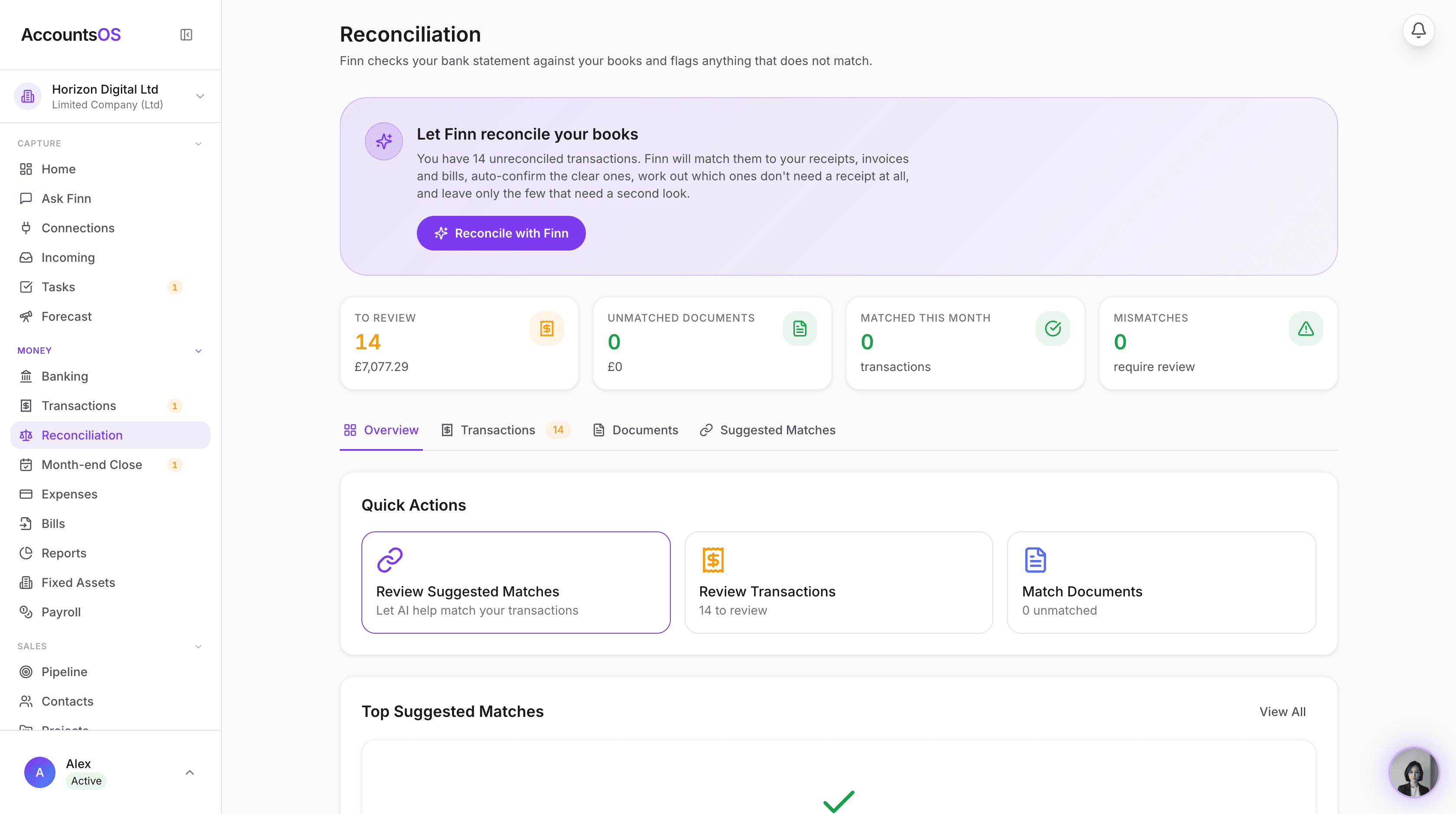
Making Tax Digital means keeping digital records and filing through software. AccountsOS does both for you. Connect your bank and HMRC, and Finn keeps the records, builds the return from your bookkeeping, and files it on your confirmation.
- Digital records kept automatically as money moves
- Returns calculated from your ledger, no bridging spreadsheet
- Submit directly to HMRC once you've checked the figures
- Every deadline tracked so nothing is filed late
Making Tax Digital for VAT has been mandatory for all VAT-registered UK businesses since April 2022. You can no longer file a VAT return through the old HMRC online portal. Every VAT return must now go through MTD-compatible software that connects directly to HMRC's API. The good news is that genuine free options exist. The honest caveat is that free MTD software handles the submission part, not the hard part. You still need to keep accurate digital records, reconcile your transactions, and calculate the nine VAT boxes yourself before the software files the numbers. For many businesses, that manual effort costs more in time than any software subscription. This page covers every credible free and low-cost MTD VAT option available in 2026, what each one actually includes, and who each is suited to.
What Does MTD-Compatible Software Actually Need to Do?
HMRC's Making Tax Digital rules have two requirements. First, you must keep digital records of your VAT transactions. Second, you must file your VAT return digitally using software that connects to HMRC's API. There must be a digital link between your records and what gets submitted: you cannot retype figures into a separate filing tool.
In practice, this means any MTD software you use must be able to: store or import your VAT transaction records, calculate the nine VAT return boxes (Box 1 through Box 9), and submit the return directly to HMRC through an authenticated connection.
Bridging software is a separate category. It connects to a spreadsheet you have already filled in and acts only as the digital link to HMRC. It satisfies the MTD rules but does not help you keep records or calculate VAT. If your bookkeeping already lives in a spreadsheet, bridging software may be all you need.
Which MTD VAT Software Is Genuinely Free?
Three options stand out as genuinely free for UK businesses in 2026, each with conditions worth understanding before you commit.
FreeAgent is the most fully featured free option. It is a complete accounting package covering invoicing, expenses, bank feeds, and VAT. The catch is eligibility: it is only free if you bank with NatWest, Royal Bank of Scotland, Ulster Bank, or Mettle. If you bank elsewhere, FreeAgent costs from around £19/month. For eligible businesses, it is a strong option with good MTD VAT support.
QuickFile has a permanently free tier aimed at smaller businesses. The free plan includes VAT return preparation and MTD submission. It starts to charge for larger accounts (typically above a certain number of ledger entries per year). For very small, low-volume businesses it is a practical choice.
My Tax Digital is a browser-based bridging tool. You enter or paste your nine VAT box figures, connect to HMRC once via Government Gateway, and file. It is genuinely free and straightforward. It is suitable only if you already know your VAT figures from a spreadsheet or external records.
| Software | Cost | What it covers | Who it suits |
|---|---|---|---|
| FreeAgent | Free (NatWest/RBS/Ulster/Mettle customers only, otherwise from ~£19/mo) | Full accounting + MTD VAT filing | Eligible bank customers wanting an all-in-one package |
| QuickFile | Free for smaller accounts | Bookkeeping + MTD VAT filing | Low-volume small businesses |
| My Tax Digital | Free | Bridging only: file from known figures | Businesses with spreadsheet-based records |
| HMRC's own portal | Free | Non-MTD filing only (no longer valid for VAT) | Not applicable since April 2022 |
What Are the Cheapest Paid MTD VAT Options?
If you do not qualify for FreeAgent's free tier and find QuickFile too limited, a category of low-cost bridging tools sits between free and full-priced accounting software. These typically charge a small annual fee and are designed for businesses that keep records in a spreadsheet and want a reliable, HMRC-approved way to file.
123 Sheets, VitalTax, and Easy MTD VAT are among the most widely used. At the time of writing, most are priced at around £30 to £50 per year for a single VAT registration. They connect to a spreadsheet, read the nine VAT boxes you have already calculated, and submit to HMRC.
The limitation is identical to free bridging: you are still doing all the bookkeeping work yourself. These tools do not categorise transactions, calculate VAT, or reduce your admin workload. They simply handle the last step of getting your figures to HMRC.
| Software | Approximate annual cost | Type | Spreadsheet link |
|---|---|---|---|
| 123 Sheets | From around £36/year | Bridging | Yes (Google Sheets / Excel) |
| VitalTax | From around £30/year | Bridging | Yes (Excel) |
| Easy MTD VAT | From around £36/year | Bridging | Yes (Excel) |
| My Tax Digital | Free | Bridging (web) | Manual entry or paste |
| QuickFile (paid) | From around £45/year for larger accounts | Full accounting | No (own records system) |
What Is the Real Cost of Free MTD Software?
Free software removes the subscription cost. It does not remove the workkeeping work. That distinction matters when you are calculating what MTD VAT compliance actually costs your business.
Every quarter, a VAT-registered business needs to: reconcile bank transactions, categorise purchases and sales correctly, account for any partial exemption, standard-rated, zero-rated, and exempt supplies, calculate Box 1 through Box 9, review for errors, and file by the deadline. With free bridging software or a basic free accounting package, you do all of that. The software handles only the last step.
For a sole trader or micro-business with simple finances and time to spare, that may be perfectly acceptable. For a busier business or one with a mix of VAT rates, multiple bank accounts, or volume of receipts, the time cost of manual bookkeeping is real. At, say, three hours per quarter at your billable rate, the maths often favours paying for software that automates the categorisation and calculation.
How Does Xero, QuickBooks, and Sage Compare on VAT?
The three dominant UK accounting packages all include MTD VAT filing as standard. They are not free, but they go well beyond what bridging tools offer: automatic bank feeds, transaction categorisation, purchase and sales ledgers, invoicing, and a live running VAT liability you can monitor throughout the quarter.
Xero starts from around £16 per month for its entry plan (Ignite), though limits on invoices and bills apply. QuickBooks starts from around £12 per month plus VAT for Simple Start. Sage starts from around £15 per month. All prices are at the time of writing and subject to change. All three are well-established on the HMRC software list and have robust MTD VAT implementations.
The criticism levelled at all three is that they have raised prices significantly in recent years while the core experience has not changed much. None of them uses AI to do the bookkeeping work for you: transactions still need manual categorisation in most cases, or rules you set up yourself. You are paying for a more sophisticated manual process, not an automated one.
| Product | Approximate entry price | MTD VAT included | AI automation |
|---|---|---|---|
| Xero Ignite | From ~£16/mo | Yes | Limited (basic suggestions) |
| QuickBooks Simple Start | From ~£12/mo + VAT | Yes | Limited |
| Sage Accounting Start | From ~£15/mo | Yes | Limited |
| AccountsOS | 14-day free trial, then £20/mo + VAT | Yes (submits directly to HMRC) | Yes (AI does the bookkeeping) |
When Is It Worth Paying for MTD Software?
The decision comes down to what you are buying. Free software buys you MTD compliance. Paid software, done well, buys you time.
Paying makes clear sense if any of these apply: you have 50 or more transactions per month and manual categorisation takes meaningful time; you receive a high volume of receipts and currently photograph, file, or forward them manually; you find yourself scrambling near each VAT deadline because the bookkeeping is not up to date; or you have more than one bank account or card to reconcile.
It also makes sense if the alternative is not free software but an accountant or bookkeeper doing the quarterly VAT work for you. Bookkeeping support typically costs from £50 to £200 per month depending on volume and geography. A platform that automates most of that work costs considerably less.
How Does AccountsOS Handle MTD VAT?
AccountsOS is an AI accounting platform built for UK founders and small businesses. It is MTD-compatible software that submits VAT returns directly to HMRC under Making Tax Digital. It is not free: after a 14-day free trial (no card required), it costs £20 per month plus VAT.
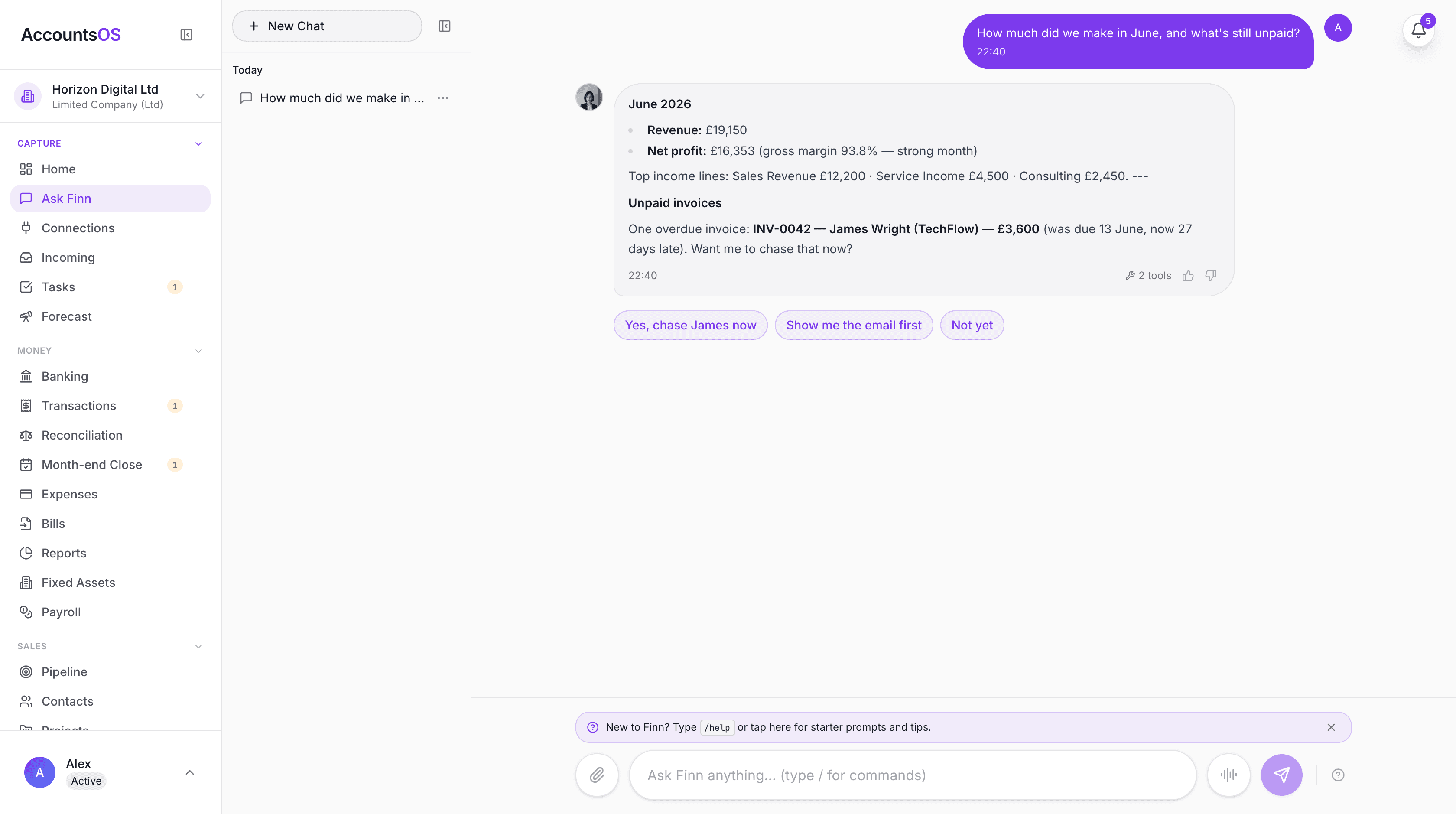
Where it differs from both free options and traditional paid software is in what it automates. The AI, Finn, categorises transactions as they arrive, captures receipts sent via WhatsApp, email, or the app, matches payments to invoices, and calculates the nine VAT boxes live throughout the quarter. When the deadline approaches, the return is ready to review and submit: you are not starting from scratch.
The £20 per month plus VAT is not a charge for the same thing as free software, done slightly better. It is a charge for removing most of the manual work that free software leaves entirely with you. For a business spending two to four hours per quarter on VAT bookkeeping, the cost typically pays for itself in time saved in the first month.
AccountsOS is built to HMRC's MTD VAT API specification and submits directly to HMRC. It is not on a waiting list and does not require a separate bridging step.
What Are the VAT Filing Deadlines Under MTD?
VAT return deadlines under MTD are the same as they were before: one calendar month and seven days after the end of the VAT period. For a standard quarterly VAT period ending 31 March, the deadline is 7 May. For a period ending 30 June, the deadline is 7 August.
Payment of any VAT owed is also due by the same deadline in most cases. HMRC operates a points-based penalty system for late filing and late payment since January 2023. A late submission earns one penalty point. Reaching the threshold for your filing frequency triggers a £200 penalty, with further £200 charges for each subsequent late return while above the threshold.
One practical implication: do not leave your bookkeeping until the final days before the deadline. With MTD, the submission itself is fast once your records are in order. The time pressure comes from getting the records straight, not from the filing process.
Frequently asked questions
Is there genuinely free MTD VAT software in the UK?
Yes. FreeAgent is free for business banking customers of NatWest, RBS, Ulster Bank, and Mettle. QuickFile has a free tier for smaller businesses. My Tax Digital is a free web-based bridging tool for businesses that already know their nine VAT box figures. All three are MTD-compatible and can file directly with HMRC.
Can I still file a VAT return through HMRC's website?
No. Since April 2022, all VAT-registered businesses must file through MTD-compatible software. The old HMRC online portal for VAT returns is no longer available for standard VAT submissions. You must use software that connects to HMRC's API.
What is bridging software and is it sufficient?
Bridging software connects your spreadsheet records to HMRC and handles the digital link required by MTD. It is sufficient under the rules if your records are already in digital form and you have calculated your nine VAT boxes yourself. It does not help with bookkeeping, transaction categorisation, or VAT calculation: that work remains entirely yours.
Is FreeAgent actually free?
FreeAgent is free only for business banking customers of NatWest, Royal Bank of Scotland, Ulster Bank, and Mettle. If you bank elsewhere, it is a paid product starting from around £19 per month at the time of writing. Always verify current pricing directly with FreeAgent, as pricing changes.
What happens if I miss a VAT deadline under MTD?
HMRC uses a points-based penalty system introduced in January 2023. Each late submission earns one penalty point. When you reach the threshold for your filing frequency (four points for quarterly filers), a £200 financial penalty applies, plus £200 for each subsequent late submission until you return below the threshold. Late payment penalties are separate and also apply.
Can I use Excel or a spreadsheet for MTD VAT?
A spreadsheet alone is not sufficient, because HMRC requires a digital link between your records and the submission. However, you can use a spreadsheet as your records system and connect it to bridging software (such as 123 Sheets, VitalTax, or Easy MTD VAT) that handles the HMRC connection. My Tax Digital lets you enter figures manually for free.
What is the difference between MTD VAT bridging software and full accounting software?
Bridging software handles only the submission step: it takes your pre-calculated VAT figures and files them with HMRC. Full accounting software (Xero, QuickBooks, Sage, AccountsOS, FreeAgent) manages your records, categorises transactions, calculates VAT throughout the period, and then files. Full software costs more but reduces the manual bookkeeping work required.
How does AccountsOS differ from free MTD VAT software?
Free MTD software leaves the bookkeeping and VAT calculation to you. AccountsOS uses AI to categorise your transactions automatically, capture receipts from WhatsApp or email, match payments to invoices, and calculate the nine VAT boxes as you go. The result is a VAT return that is largely ready when the deadline arrives, rather than one you build from scratch each quarter. It costs £20 per month plus VAT after a 14-day free trial.
Do I need to register separately with HMRC to use MTD VAT software?
You need to be registered for MTD for VAT with HMRC, which most VAT-registered businesses were migrated to automatically when it became mandatory. When you connect any MTD software to HMRC for the first time, you authorise it through your Government Gateway account. The software then holds the connection and can submit on your behalf.
Is AccountsOS approved by HMRC?
AccountsOS is MTD-compatible software built to HMRC's MTD VAT API specification and submits VAT returns directly to HMRC under Making Tax Digital. For the most current information on HMRC's software recognitions, check the HMRC website directly.
Related MTD guides
MTD for VAT Software UK 2026: Submit Your VAT Return Directly to HMRC
MTD for VAT software keeps your VAT records digitally and submits your VAT return directly to HMRC. Every VAT-registered UK business must file this way. AccountsOS is connected to HMRC's Making Tax Digital for VAT service in production: it calculates your nine-box return live from your bookkeeping and, on your confirmation, files it directly to HMRC. Unlike software that just hands you the nine boxes to fill in, the AI does the categorising and the calculation for you. From £20 a month plus VAT after a 14-day free trial.
Best MTD Software UK 2026: Free and Paid Options Compared
Several free MTD-compatible software options exist for UK taxpayers, including QuickFile, My Tax Digital, and FreeAgent (free via NatWest or Mettle banking). Paid all-in-one options include Xero, QuickBooks, and Sage. AccountsOS is MTD-compatible software that uses AI to do the bookkeeping for you and submits your VAT return directly to HMRC, from £20 a month plus VAT after a 14-day free trial.
VAT Bridging Software UK 2026: What It Is, Whether You Need It, and What to Use Instead
VAT bridging software is a tool that takes the 9 VAT figures from your spreadsheet and submits them to HMRC via the MTD API, creating the required digital link without changing how you keep records. It is mandatory to file through MTD-compatible software for all VAT-registered UK businesses since April 2022, and bridging software is the minimum-effort route if you want to keep using spreadsheets. However, bridging software does no bookkeeping: it is a filing tool only, not an accounting solution.
Making Tax Digital for VAT: Complete Compliance Guide (2026)
MTD for VAT is mandatory for all VAT-registered businesses regardless of turnover since April 2022. You must keep digital VAT records and submit your VAT return through MTD-compatible software — not the HMRC online portal.
How to Submit Your VAT Return to HMRC Under MTD (2026 Step-by-Step)
To submit a VAT return under Making Tax Digital (MTD), you must use MTD-compatible software connected to HMRC via OAuth authorisation. Your software calculates the 9-box VAT figures from your digital records, you review them, and submit directly to HMRC through the software. The old HMRC online portal can no longer be used by VAT-registered businesses to file returns.
Get MTD-ready with AccountsOS
Connect your bank and HMRC, and let Finn keep the records, build the return and submit it for you. Be ready for Making Tax Digital without the admin.
Free for 14 days. No credit card required.