How to Submit Your VAT Return to HMRC Under MTD (2026 Step-by-Step)
To submit a VAT return under Making Tax Digital (MTD), you must use MTD-compatible software connected to HMRC via OAuth authorisation. Your software calculates the 9-box VAT figures from your digital records, you review them, and submit directly to HMRC through the software. The old HMRC online portal can no longer be used by VAT-registered businesses to file returns.
Who must use MTD for VAT
All VAT-registered businesses in the UK, mandatory since April 2022
How to file
Through MTD-compatible software connected to HMRC via OAuth. The old HMRC online portal cannot be used
Filing frequency
Quarterly for most businesses; monthly stagger periods also available
Submission deadline
1 calendar month and 7 days after the end of the VAT period (e.g. period ending 31 March: deadline 7 May)
Payment deadline
Usually the same date as the submission deadline
Number of boxes
9 boxes in total; Box 5 is the net VAT to pay or reclaim
Late submission penalty
Points-based system: one penalty point per late return, a fixed £200 penalty once the threshold is reached, plus interest on late payment
Free trial
AccountsOS offers a 14-day free trial, then £20 per month + VAT
Compliant without the manual work
Making Tax Digital means keeping digital records and filing through software. AccountsOS does both for you. Connect your bank and HMRC, and Finn keeps the records, builds the return from your bookkeeping, and files it on your confirmation.
- Digital records kept automatically as money moves
- Returns calculated from your ledger, no bridging spreadsheet
- Submit directly to HMRC once you've checked the figures
- Every deadline tracked so nothing is filed late
Since April 2022, every VAT-registered business in the UK must file VAT returns through Making Tax Digital (MTD). That means using MTD-compatible software to keep digital VAT records and submit returns directly to HMRC via their API. The old method of logging into the HMRC website and typing in figures is no longer an option for VAT. This guide walks through exactly how MTD VAT submission works in practice: what you need before you start, how the 9 boxes are calculated, the step-by-step submission process, what deadlines apply, and what happens after you file. Whether you are submitting your first MTD return or switching from an older setup, this reference covers everything you need to get it right and avoid penalties.
Who Must Submit VAT Returns Under MTD?
Making Tax Digital for VAT has applied to all VAT-registered businesses since April 2022. There are no turnover thresholds and no exemptions based on business size. Whether you are a sole trader, a limited company, a partnership, or a charity with a VAT registration, you are required to keep digital VAT records and submit returns through MTD-compatible software.
Exemptions are very limited and must be applied for separately from HMRC. They cover situations where it is not reasonably practicable to use software due to disability, age, remoteness, or other reasons. The vast majority of VAT-registered businesses do not qualify for an exemption and must comply.
If your business has recently crossed the VAT registration threshold (currently £90,000 in annual taxable turnover for the 2025-26 tax year), you will need to register for MTD at the same time as you register for VAT. Voluntarily VAT-registered businesses are also required to use MTD.
What You Need Before You Can Submit
Three things must be in place before you can file your first MTD VAT return: digital VAT records, an MTD sign-up with HMRC, and MTD-compatible software authorised to speak to HMRC on your behalf.
Digital VAT records means keeping your VAT account, output tax records, and input tax records in a digital format throughout the period. A spreadsheet that is then manually keyed into a portal does not meet this requirement. Your records must flow digitally from source to submission, which is what MTD-compatible software handles.
To sign up for MTD for VAT, you (or your accountant) do this through your Government Gateway account at gov.uk/register-for-making-tax-digital-for-vat. You will need your VAT registration number and the effective date of registration. Once signed up, HMRC places your VAT record into the MTD system.
Finally, you need MTD-compatible software. This is software built to HMRC's MTD VAT API specification. You authorise it once using an OAuth flow (the software redirects you to HMRC, you log in, and grant permission), and it then has the authority to pull your VAT obligations and submit returns on your behalf.
The 9 Boxes of a VAT Return Explained
Every VAT return, regardless of how it is filed, contains the same 9 boxes. Understanding what each box represents helps you review the figures your software has calculated before submitting.
Good MTD software calculates all 9 boxes automatically from your transaction records. Your job is to review them and confirm they look right before submitting.
| Box | Label | What goes here |
|---|---|---|
| Box 1 | VAT due on sales | Output VAT charged on your sales and other supplies during the period |
| Box 2 | VAT due on EC acquisitions | VAT due on acquisitions of goods from EU member states; mostly nil for GB businesses post-Brexit |
| Box 3 | Total VAT due | The sum of Box 1 and Box 2 |
| Box 4 | VAT reclaimed on purchases | Input VAT you are reclaiming on business purchases and expenses during the period |
| Box 5 | Net VAT to pay or reclaim | The difference between Box 3 and Box 4. If Box 3 is higher, you owe HMRC; if Box 4 is higher, HMRC owes you a repayment |
| Box 6 | Total value of sales ex VAT | The total value of your taxable and zero-rated sales, excluding VAT |
| Box 7 | Total value of purchases ex VAT | The total value of your purchases and expenses, excluding VAT |
| Box 8 | Total value of goods sent to EU | Value of goods supplied to VAT-registered customers in EU member states; nil for most GB businesses post-Brexit |
| Box 9 | Total value of goods acquired from EU | Value of goods acquired from EU member states; nil for most GB businesses post-Brexit |
Step-by-Step: How to Submit a VAT Return Under MTD
The process below applies to all MTD-compatible software. The exact screens differ between products, but the underlying steps are the same.
Step 1: Keep digital VAT records throughout the period. This happens automatically if you are using MTD-compatible accounting software, as every sale and purchase is recorded in real time. If you are using bridging software with a spreadsheet, your spreadsheet must be kept digitally and linked to the bridging software without any manual re-keying.
Step 2: Check that your business is signed up for MTD with HMRC. If you have not done this yet, go to gov.uk/register-for-making-tax-digital-for-vat. Your software will not be able to retrieve your VAT obligations or submit returns until MTD sign-up is complete.
Step 3: Authorise your MTD software to connect to HMRC. Most software does this via an OAuth flow the first time you go to submit. You are redirected to HMRC's Government Gateway, you log in, and you grant the software permission to interact with your VAT record. This authorisation lasts for 18 months and then needs to be renewed.
Step 4: Review the 9-box figures your software has calculated. Check that the output VAT (Box 1) looks right for the period's sales, and that the input VAT (Box 4) reflects the purchases you have records for. If a figure looks off, investigate the underlying transactions before submitting.
Step 5: Submit the return through your software. There is usually a 'Submit to HMRC' button or equivalent. Your software sends the 9-box figures to HMRC's API.
Step 6: Receive and save HMRC's confirmation. HMRC sends back a confirmation receipt with a submission reference. Your software should store this automatically. Keep this receipt as proof of submission.
Step 7: Pay any VAT due by the deadline. If Box 5 shows an amount you owe HMRC, payment must be made by the same deadline as the return (1 calendar month and 7 days after the period end). Pay via your HMRC online account or by bank transfer using your VAT registration number as the reference.
VAT Return Deadlines and Filing Periods
For most businesses, VAT periods are quarterly. HMRC assigns one of three stagger groups, which determines which months your VAT periods end in. The submission and payment deadline is always 1 calendar month and 7 days after the end of the VAT period.
Some businesses file monthly, typically to benefit from faster VAT repayments (for example, businesses that regularly reclaim more VAT than they charge). The same deadline rule applies: 1 calendar month and 7 days after the month end.
Missing a deadline is what triggers the points-based penalty system. Keep the dates below to hand.
| VAT period ends | Submission and payment deadline |
|---|---|
| 31 January | 7 March |
| 28/29 February | 7 April |
| 31 March | 7 May |
| 30 April | 7 June |
| 31 May | 7 July |
| 30 June | 7 August |
| 31 July | 7 September |
| 31 August | 7 October |
| 30 September | 7 November |
| 31 October | 7 December |
| 30 November | 7 January |
| 31 December | 7 February |
What Happens After You Submit?
Once your software has sent the return to HMRC, HMRC processes it and sends back a confirmation. This usually happens within seconds for digital submissions. The confirmation contains a submission reference number, which your software should record automatically. This reference is your proof of submission.
If you owe VAT (Box 5 is positive), you still need to make payment separately. Submitting the return does not trigger automatic payment. You pay through your HMRC online account, via bank transfer (sort code 08-32-00, account number 11963155, reference your 9-digit VAT registration number), or by Direct Debit if you have set one up in advance.
If HMRC owes you a repayment (Box 5 is negative), repayments are usually made within 30 days of the return being received. They are paid to the bank account registered with HMRC. If you have not provided bank details, set them up in your VAT online account to avoid delays.
HMRC may occasionally open an enquiry into a VAT return. If this happens, you will receive a letter. This is separate from the submission process and is not triggered by submitting through MTD.
Penalties for Late VAT Returns and Late Payment
HMRC introduced a points-based penalty system for late VAT returns from January 2023, replacing the old default surcharge regime. The system works as follows.
Each time you submit a VAT return late, you receive one penalty point. Once your total points reach the threshold for your filing frequency (2 points for annual filers, 4 for quarterly filers, 5 for monthly filers), HMRC charges a fixed £200 penalty. A further £200 penalty is charged for each subsequent late return while you are at the threshold.
Points expire after 24 months if you have no further late returns, or you can reset your points to zero by filing all returns on time for a set period (12 consecutive months for annual filers, 6 months for quarterly, and 6 months for monthly).
Separate to late-return penalties, HMRC charges late-payment penalties and interest on VAT that is paid after the deadline. The penalty rate increases the longer the payment remains overdue. Interest is also charged from the first day the payment is late.
The practical takeaway: file on time even if you cannot pay on time. Late filing and late payment are penalised separately, and filing on time removes the risk of accumulating late-return penalty points.
Common Errors to Avoid When Filing Under MTD
The most common errors on MTD VAT returns are not unique to digital filing, but MTD makes some of them easier to spot and some harder to miss.
Forgetting to include all income. If you have multiple sales channels (for example, online sales via a marketplace plus direct sales), make sure all income is captured in your digital records before the return is calculated. A return that omits a revenue stream will understate Box 1 and Box 6.
Claiming input VAT without a valid VAT invoice. HMRC can disallow input tax claims if you cannot produce a valid VAT invoice for the purchase. Your software may process a transaction, but the right to reclaim VAT depends on the underlying document.
Submitting before all transactions for the period are recorded. If you have bank transactions or supplier invoices from the last days of the period that have not been processed yet, submitting early can mean the return is incomplete. Review the period-end date and confirm everything is in.
Authorisation gaps. If your software's HMRC connection has lapsed (authorisations last 18 months), your submission will fail. Re-authorise the connection before the deadline, not on the day you try to submit.
Wrong VAT period selected. Especially if you are catching up on late returns, confirm that the period dates on your submission match the HMRC obligation you are fulfilling.
Using the old HMRC online portal. The portal will not accept returns from VAT-registered businesses that are enrolled in MTD. If you try to file this way, it will fail or be rejected. You must file through your MTD software.
Frequently asked questions
Can I still submit my VAT return through the HMRC website?
No. Since April 2022, all VAT-registered businesses must submit returns through MTD-compatible software connected to HMRC via their API. The old HMRC online portal (where you typed in your 9-box figures directly) is no longer available for MTD-enrolled businesses. You must use software that has been built to HMRC's MTD VAT API specification.
What is the VAT return deadline under MTD?
The submission deadline is 1 calendar month and 7 days after the end of your VAT period. For a quarterly period ending 31 March, the deadline is 7 May. The payment deadline is usually the same date. Missing the deadline triggers a penalty point under HMRC's points-based system, with a fixed £200 penalty once the threshold is reached.
How do I connect my software to HMRC for MTD?
Your MTD-compatible software will guide you through an OAuth authorisation flow. You are redirected to HMRC's Government Gateway, where you log in with your Government Gateway credentials and grant the software permission to interact with your VAT record. This authorisation lasts 18 months. You only need to do it once per piece of software, and then the software can retrieve your VAT obligations and submit returns on your behalf.
What does Box 5 of the VAT return mean?
Box 5 is the net VAT figure: the difference between Box 3 (total VAT due, being the sum of Box 1 and Box 2) and Box 4 (VAT reclaimed on purchases). If Box 3 is greater than Box 4, Box 5 is the amount you owe HMRC for the period. If Box 4 is greater than Box 3, Box 5 is the amount HMRC owes you as a repayment.
What are Boxes 8 and 9 on the VAT return?
Box 8 is the total value of goods supplied to VAT-registered customers in EU member states, and Box 9 is the total value of goods acquired from EU member states. For the vast majority of GB-based businesses since Brexit, both boxes are nil. If you trade in goods (not services) with EU businesses, you may still need to complete these boxes.
What happens if I miss a VAT return deadline?
Under HMRC's points-based penalty system, each late return earns one penalty point. Once your points reach the threshold for your filing frequency (4 points for quarterly filers), HMRC charges a fixed £200 penalty. Further late returns while at the threshold each attract another £200 penalty. Separate late-payment penalties and interest apply if you also pay late. Filing on time, even if you cannot pay, avoids accumulating points.
Can AccountsOS submit my VAT return directly to HMRC?
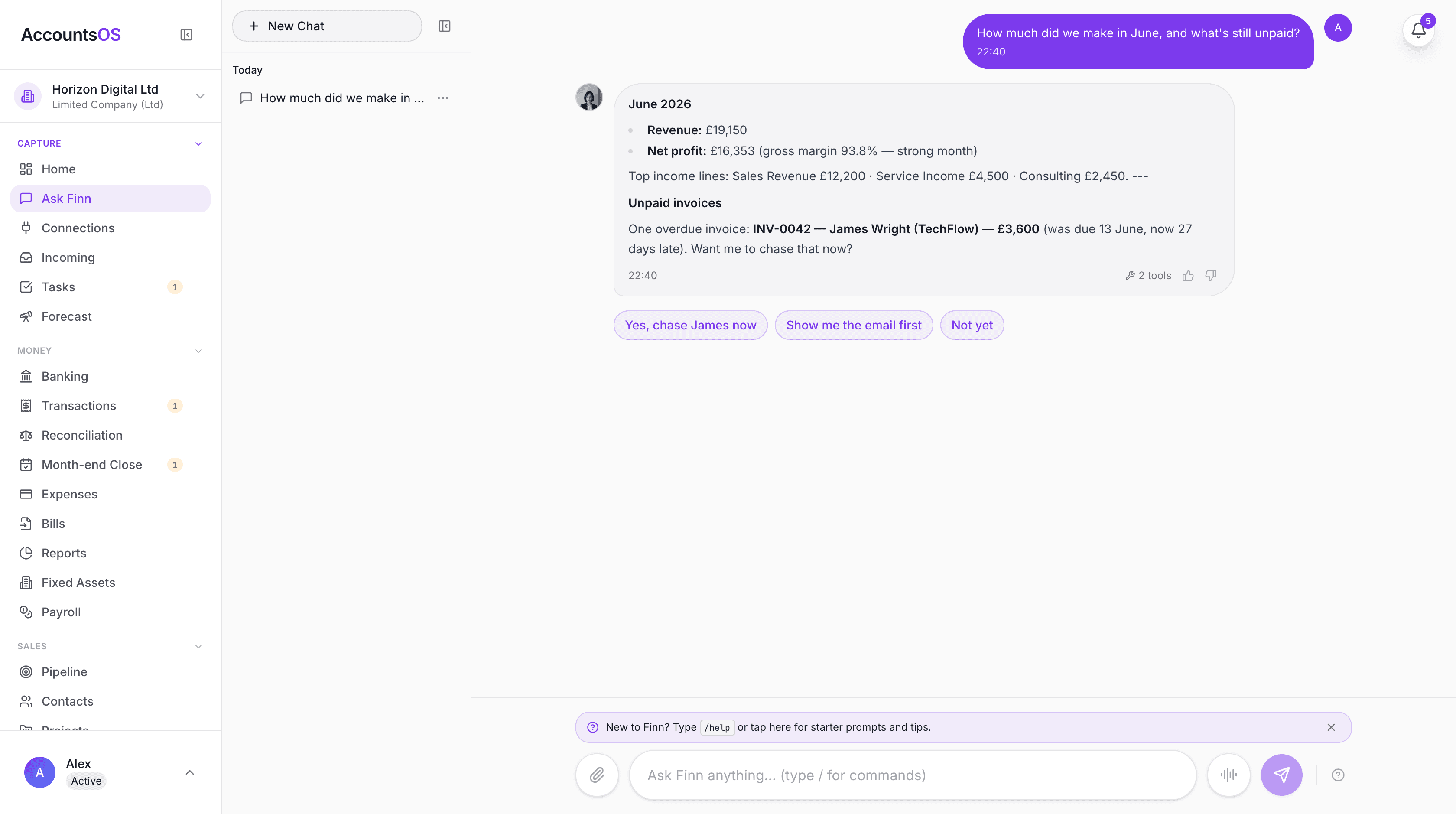
Yes. AccountsOS is MTD-compatible software built to HMRC's MTD VAT API specification. It calculates your 9-box VAT figures in real time as you record transactions throughout the period. When you are ready to file, you review the figures and submit directly to HMRC through AccountsOS. The platform stores HMRC's confirmation receipt against the period. You can also ask Finn, the AI accountant built into AccountsOS, to walk you through the submission with a confirmation step. AccountsOS offers a 14-day free trial, then £20 per month + VAT.
Do I need to keep digital VAT records under MTD?
Yes. MTD for VAT requires you to keep digital records of your VAT account, output tax, and input tax. You cannot manually re-key figures from a paper record into software. The digital trail must run from the source transaction through to the submission. MTD-compatible accounting software handles this automatically when you record sales and purchases in the platform.
How long does HMRC take to process a VAT repayment?
HMRC aims to repay within 30 days of receiving the VAT return. Repayments are made to the bank account registered with HMRC for your VAT record. If you have not yet provided bank details, add them in your VAT online account to avoid delays. In most cases, repayments for straightforward returns arrive significantly faster than 30 days.
What is bridging software and do I need it?
Bridging software is a type of MTD-compatible software that connects a spreadsheet to HMRC's MTD API. You maintain your VAT records in a spreadsheet, and the bridging software reads the 9-box figures and submits them to HMRC digitally. It is a compliant option under MTD, but it places more manual work on you than a full MTD accounting platform, where transactions flow automatically from records to return.
Related MTD guides
MTD for VAT Software UK 2026: Submit Your VAT Return Directly to HMRC
MTD for VAT software keeps your VAT records digitally and submits your VAT return directly to HMRC. Every VAT-registered UK business must file this way. AccountsOS is connected to HMRC's Making Tax Digital for VAT service in production: it calculates your nine-box return live from your bookkeeping and, on your confirmation, files it directly to HMRC. Unlike software that just hands you the nine boxes to fill in, the AI does the categorising and the calculation for you. From £20 a month plus VAT after a 14-day free trial.
Making Tax Digital for VAT: Complete Compliance Guide (2026)
MTD for VAT is mandatory for all VAT-registered businesses regardless of turnover since April 2022. You must keep digital VAT records and submit your VAT return through MTD-compatible software — not the HMRC online portal.
Free MTD VAT Software UK 2026: Your Options, Honestly Compared
Yes, free MTD VAT software is available in the UK. FreeAgent is free for NatWest, RBS, Ulster and Mettle business banking customers. QuickFile is free for smaller businesses, and My Tax Digital offers free bridging for filing only. All three are MTD-compatible and can submit VAT returns directly to HMRC. The trade-off: free software leaves the bookkeeping and VAT calculation work entirely to you.
VAT Bridging Software UK 2026: What It Is, Whether You Need It, and What to Use Instead
VAT bridging software is a tool that takes the 9 VAT figures from your spreadsheet and submits them to HMRC via the MTD API, creating the required digital link without changing how you keep records. It is mandatory to file through MTD-compatible software for all VAT-registered UK businesses since April 2022, and bridging software is the minimum-effort route if you want to keep using spreadsheets. However, bridging software does no bookkeeping: it is a filing tool only, not an accounting solution.
Making Tax Digital Penalties: Late Submission Fines Explained
MTD uses a points-based penalty system. Each late submission earns 1 penalty point. When you reach 4 points, you receive a £200 fine. The good news: the soft landing year (2026/27) means no penalty points for late quarterly updates — but the Final Declaration deadline of 31 January 2028 is still enforced.
Get MTD-ready with AccountsOS
Connect your bank and HMRC, and let Finn keep the records, build the return and submit it for you. Be ready for Making Tax Digital without the admin.
Free for 14 days. No credit card required.